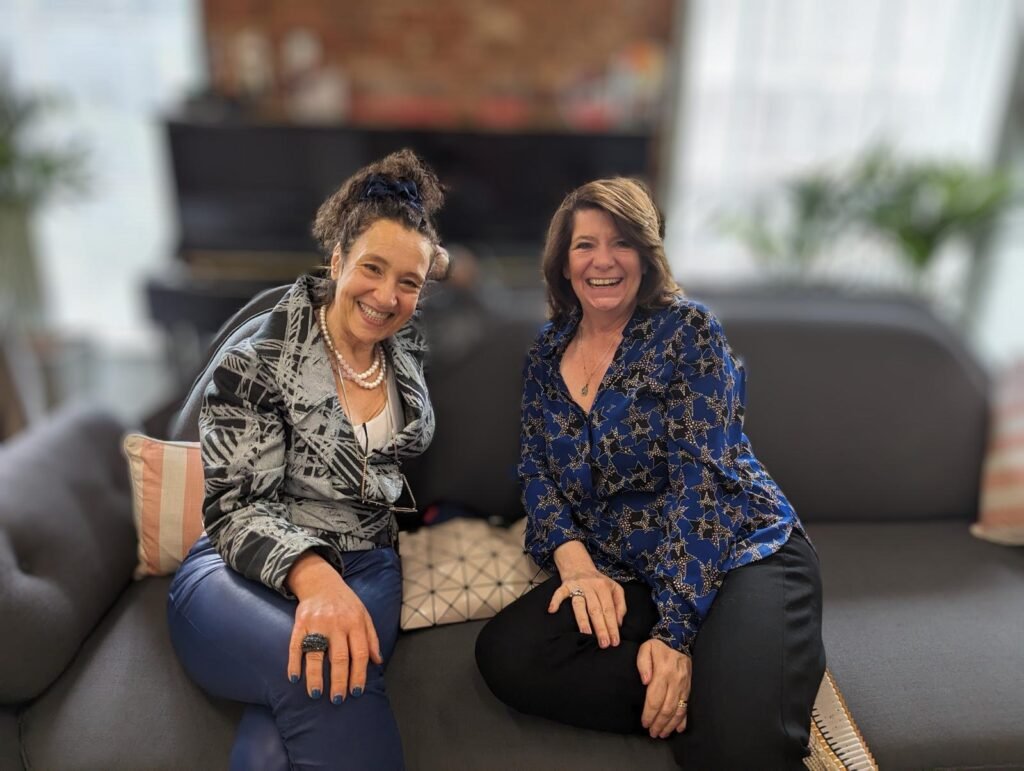
On the day of the publication of the 10th Anniversary Edition of The Glass Wall, success strategies for women at work and businesses that mean business, authors Kathryn Jacob OBE and Sue Unerman sat down together to reflect on what has and has not changed in the last ten years in our industry.
Clearly a great deal has happened. Remote working was rare in 2016. We could not have imagined a pandemic and only working from home. And the AI revolution was a vision not the reality of today.
Here’s some of our thoughts:
Sue: “It’s fair to say I think that you are more glass half full than I am about the last decade in advertising and media.”
Kathryn: “Yes, I think there has been significant progress in some areas. WACL are doing more for gender equality, and are running a significant effort to get 50% of CEO’s as women. The Ad Association has launched All In, the only survey of inclusion that covers the whole sector. Time To have been running strong campaigns such as “Where do you draw the line” against sexual harassment in the UK ad industry.
Sue: However Time To is still reporting “The Silence Barrier”, the severe lack of official reporting, and 1 in 4 respondents have experienced harassment.
We obviously spoke to many new individuals (as well as to many of our original sources to see what they thought had changed) and I personally was shocked by some of the instances described by GenZ women, those who are new to the workforce in the last decade, both in terms of actual physical harassment and in terms of inappropriate banter.
Kathryn: Another big change is the menopause. You might have thought it didn’t exist ten years ago, nobody was talking about it. So, the fact that a very human event is not hidden is a good thing. And every company with more than 250 employees will have to have a menopause policy according to the law. But then there is the law of unintended consequences. Particularly in an advertising sector where we don’t have a huge number of people working in the industry over the age of 50 anyway. So in the wrong culture at work the menopause could become a bit of a lazy shorthand to write off older women. The workplace is contracting and not just in our sector. Women over 45 seem to be getting characterised as not being flexible enough to change, and adapt to new ways of working. It’s a very lazy assumption and has led to a brain drain of talent and experience. There’s a cohort of highly talented older women (and older men) who just seem to be falling out of the industry not because of their talents but just because of the date they were born. I don’t have up to date statistics for advertising, but a recent report from the Centre for Aging Better found that there were vastly more women than men in their 50s and 60s who were out of the workforce.
Sue: Some of this is because of caring responsibilities. Caring, both for small children, and for aging parents or relatives, still often falls to women first. This has meant that more women than men are also taking advantage of remote working. Which is fine, but adds to the stress of juggling everything and means that for some businesses those women are now invisible and passed over in the office.
Now, another huge change is the use of AI in terms of recruitment. People are using AI to write applications at scale, and recruiters are using AI to sort those increased applications. We know that this is, at the moment at least, gendered. One study, in Nature magazine in October 2025 demonstrated this. Stanford researchers fed ChatGBT identical cvs. When cvs were judged the women were assumed to be younger and less experienced and less valuable.
Kathryn: It does seem like the system at work has not changed. There are admirable and important efforts to improve things for a fairer workplace, but we don’t see that the lived experiences of the people we have been talking to have improved enough.
Sue: That’s why this book is still valid, and just as it helped women last time (many women told us this), the new updated and expanded edition can and will help every woman at work today.
Book out now.
Follow us on Insta @GlassWall10Book