The use of images in advertising is powerful and effective. Images using universal archetypes are supercharged.
Archetypal images are very ancient pictures that have been shared over millennia and which have hidden meaning for the unconscious mind. Carl Jung believed that they live in the collective unconscious and that they have power beyond the superficial.
The use of archetypal images in advertising has been chronicled by Margaret Mark and Carol S. Pearson in their book “The Hero and the Outlaw: building extraordinary brands through the power of archetypes”. This led to innumerable workshops where brand managers and agencies debated whether their brand was in fact, hero, outlaw, magician, king, jester or mother. The role of the archetype is to link the brand story to an ancient narrative which gives it layers of meaning.
The authors write: “Advertising has always used archetypal imagery to market products. The Jolly Green Giant is, after all, the archetype of the Green Man, a figure associated with fertility and abundance. The judicious use of such symbolism can fuel a leading brand. Brand icons go further. It is not just that archetypal symbols and images are used to position the brand, but that, over time, the brand itself takes on symbolic significance.” A powerful tool then in the arsenal of brand building.
In one example the book cites Apple’s logo, saying that it evokes the first act of rebellion in the Garden of Eden, “a powerful distillation of the brand’s iconoclastic identity.”
In 2022 Professor Islam Issa hosted a documentary feature on BBC Radio 3, “Forbidden Fruit” which explored the imagery of the apple in the Garden of Eden, (and by the way claimed that the forbidden fruit wasn’t in fact an apple!) and discussed with me the use of the apple in advertising and branding.
I was reminded of the power of the archetypal image when I recently saw the “Enough” campaign to deter stalking and harassment against women and girls. The Home Office is to be congratulated for investing in this important issue. This campaign is going to raise awareness of the importance of relationship boundaries and hopefully act as a deterrent to violence which statistics show is increasing.
The images in the posters running in my local gym use snakes to show abhorrent and inappropriate behaviour. The snake is often wrapped around a woman in an everyday scenario waiting for a bus or at work, in order to highlight controlling and abusive behaviour like constant texting and sharing intimate images.
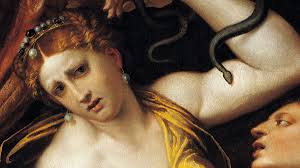
The snake is a complicated, even nuanced, archetype. A snake was guilty of enticing Eve to taste forbidden fruit in the Garden of Eden. It makes a victim of Eve, who however, still took the blame for the ending of paradise. (I personally think that Adam would have been bound to try the apple himself anyway.) In Genesis the snake is the bad guy, to blame for the fall of humanity. However, across other cultures the snake’s practice of shedding its skin makes it a primal symbol of immortality and growth. Carl Jung’s serpent archetype is of unconscious and personal transformation. In “Thus spoke Zarathustra” Nietzsche links snakes to wisdom, renewal and growth. It appears both as a loyal companion to Zarathustra, offering support, but also as a dangerous creature that thrusts him into extreme confrontations. Nietzsche’s depiction is of creature that represents the bravery that is required to navigate the complexities of life. At the recent “Le Mystere Cleopatre” at the Institut du Monde Arabe in Paris there was an entire room dedicated to paintings of Cleopatra and the asp showing how fascinated the masculine gaze of artists has been over hundreds of years by her and her death by snake.
So, a nuanced image in archetypal terms. I’d like to see a cockroach representing the hideous and dangerous practices in the “Enough” ads. Or a rat. No complexity there.